A theoretical overview of ecological dynamics and complexity
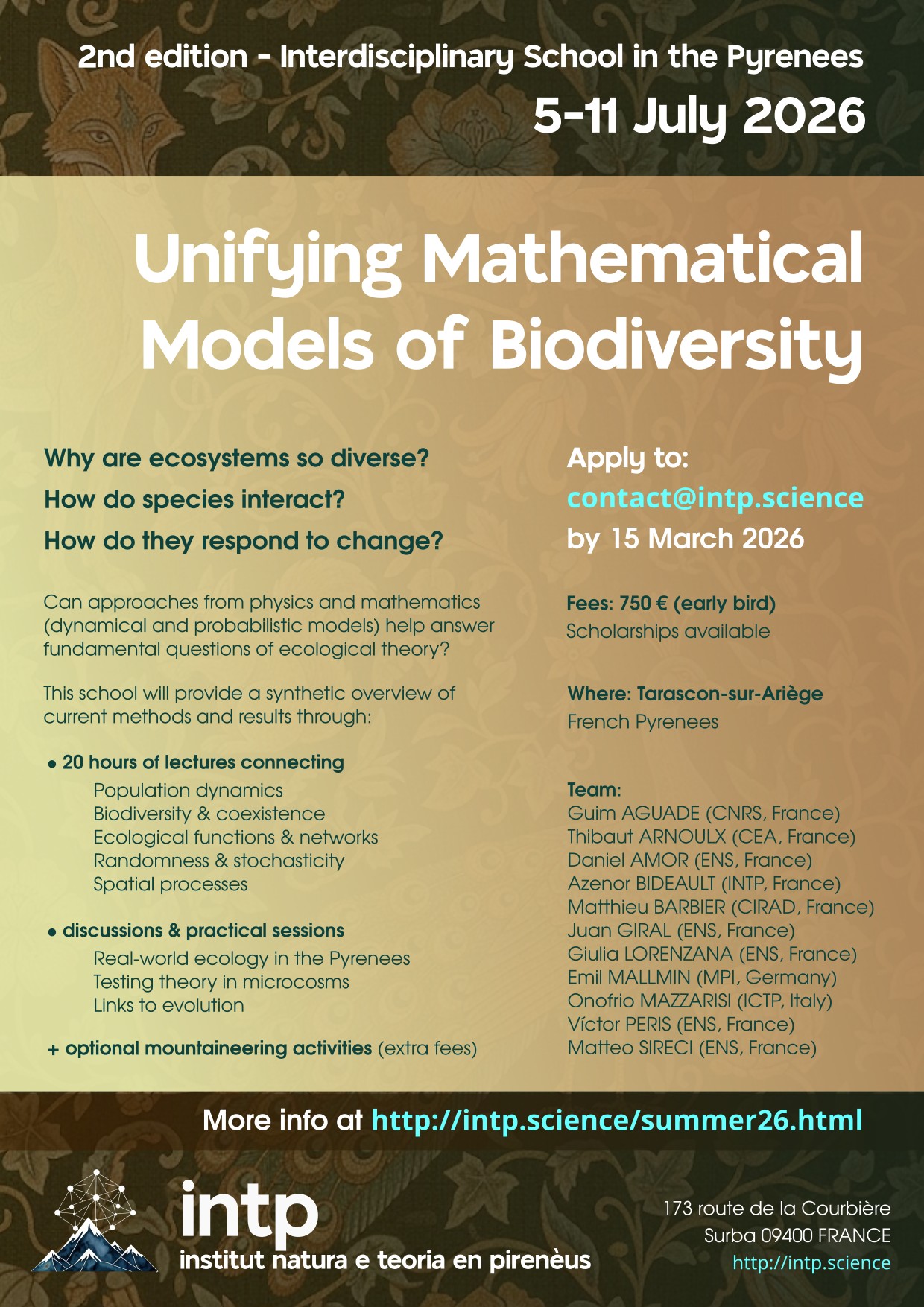
2nd edition - Interdisciplinary Summer School @ INTP
For many interdisciplinary researchers and mathematical modelers, contributing to human understanding of biodiversity and ecosystems is a growing interest and concern.
These fundamental questions have structured the science of ecology for a century, yet it is not always obvious how mathematical modelling can help solve them.
This school offers a state-of-the-art overview for theoreticians from physics or adjacent fields (e.g. applied mathematics, chemistry, computer science) who are interested in discovering these topics or acquiring a more unified perspective on them. We will focus on how tools of dynamical systems and probability combine with existing ecological theory to shed light on interactions and complexity in ecosystems.
The field of community ecology spans the gap between two scales: individual organisms, and large-scale ecosystem processes (e.g. the carbon cycle). When we focus on only one of these scales, it is arguably easier to develop quantitative models grounded in mathematics, chemistry and physics.
The middle ground is the challenging domain of biodiversity: how different biological populations interact, the emergence and persistence of networks and ecosystems, and the causes and consequences of their composition and diversity.
Ecology is a highly empirical and fragmented discipline, and it can be difficult to find a good entry point from other fields. Existing textbooks offer inside views of the discipline, but the core ideas that have shaped it often remain implicit.
It may take years for an outside viewer to form a coherent picture of how to connect these puzzle pieces, why different perspectives coexist, and especially which questions are worth asking. This school aims to facilitate that process by translating as many of these pieces as possible in a unified language.
This school is meant for students (Masters and up) and researchers from physics and other mathematical disciplines, at all levels of expertise, who are interested in discovering community ecology or acquiring a broader and more unified perspective of this field.
The style is that of physics: driven by theoretical concepts and mathematical objects, but focused more on understanding their phenomenology (through calculation and numerics) than on rigorous proof.
Our main language will be continuous deterministic and stochastic dynamical systems, as well as linear algebra, and we will focus on how mathematical objects can be related to the empirical world. Therefore, a background in nonlinear and statistical physics and neighboring fields (e.g. applied mathematics, theoretical chemistry, computer science) is the most appropriate.
One originality compared to most schools is that the team works collaboratively on creating all materials, and will rotate across the years, to progress toward unifying our perspectives rather than offer a scattershot of expert knowledge. Our aim is to eventually write a foundational textbook that synthesizes the role of mathematical modelling in understanding biodiverse ecosystems.
Our focus is on identifying the most important and characteristic directions and intuitions in this field of knowledge, what can be unified and connected, at the cost of leaving aside equally interesting but more specific approaches and results.
The lecture materials are created by a team of researchers with a physics background, currently working on both sides of the interface between physics and community ecology.
The school is organized by the INTP, a communal research lab and residence center run as a non-profit by a mix of academic and independent researchers, which organizes such schools without funding from public institutions.
The INTP aims to foster better research practices (deeper dialogue, slower science) and lifestyles (non-urban, freelance or part-time careers), and such scientific events allow it to exist and develop its activities.
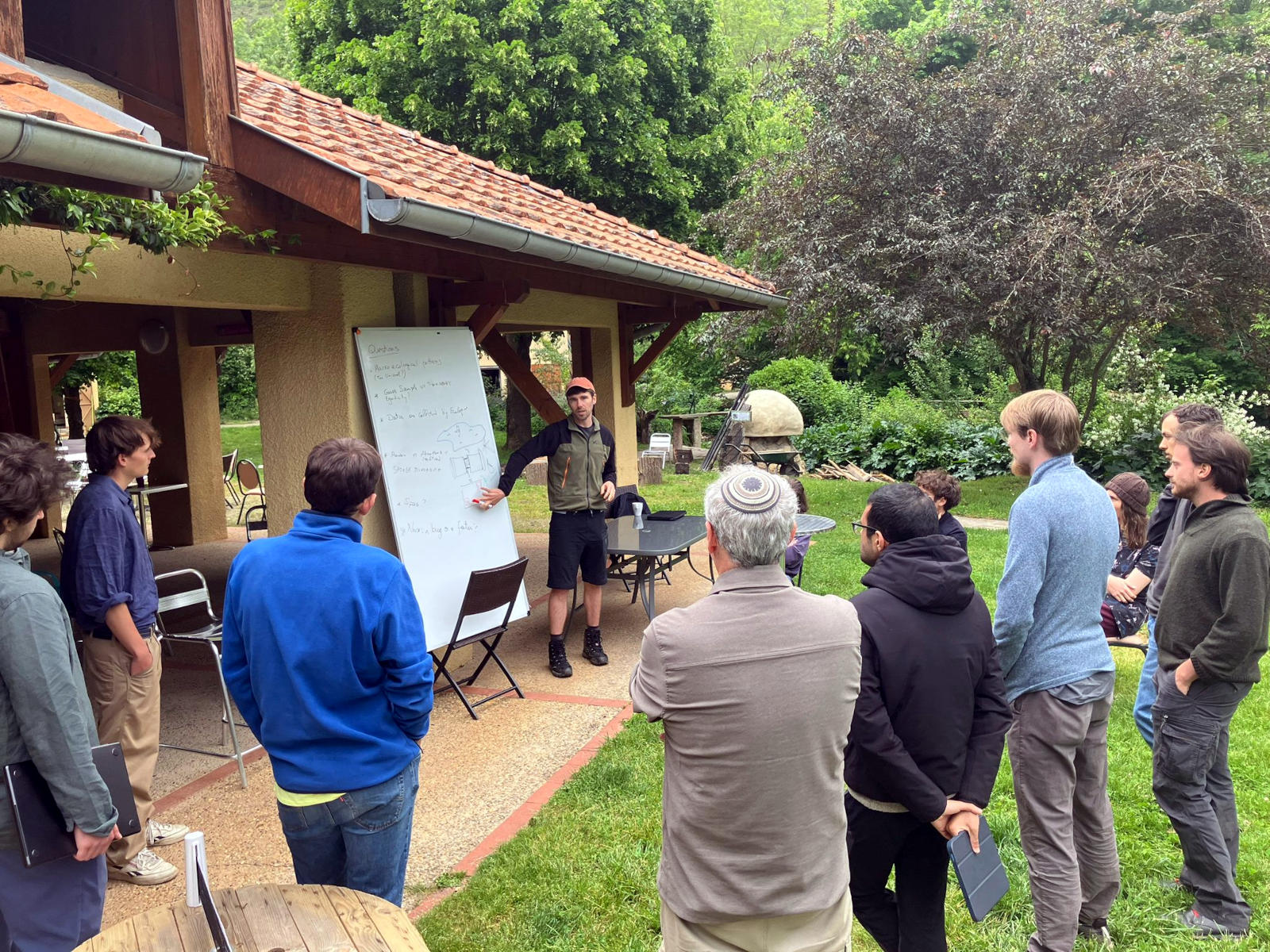
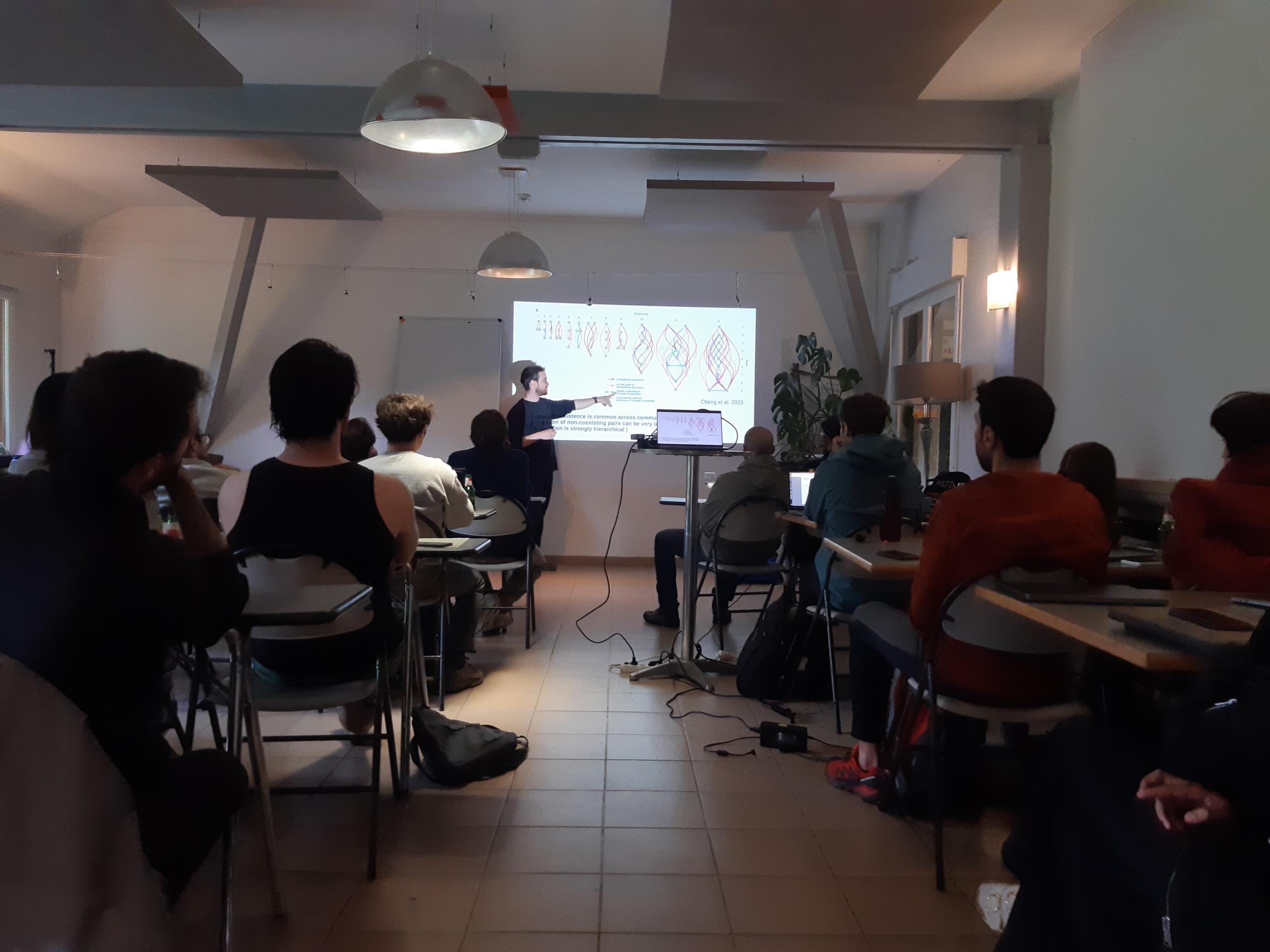
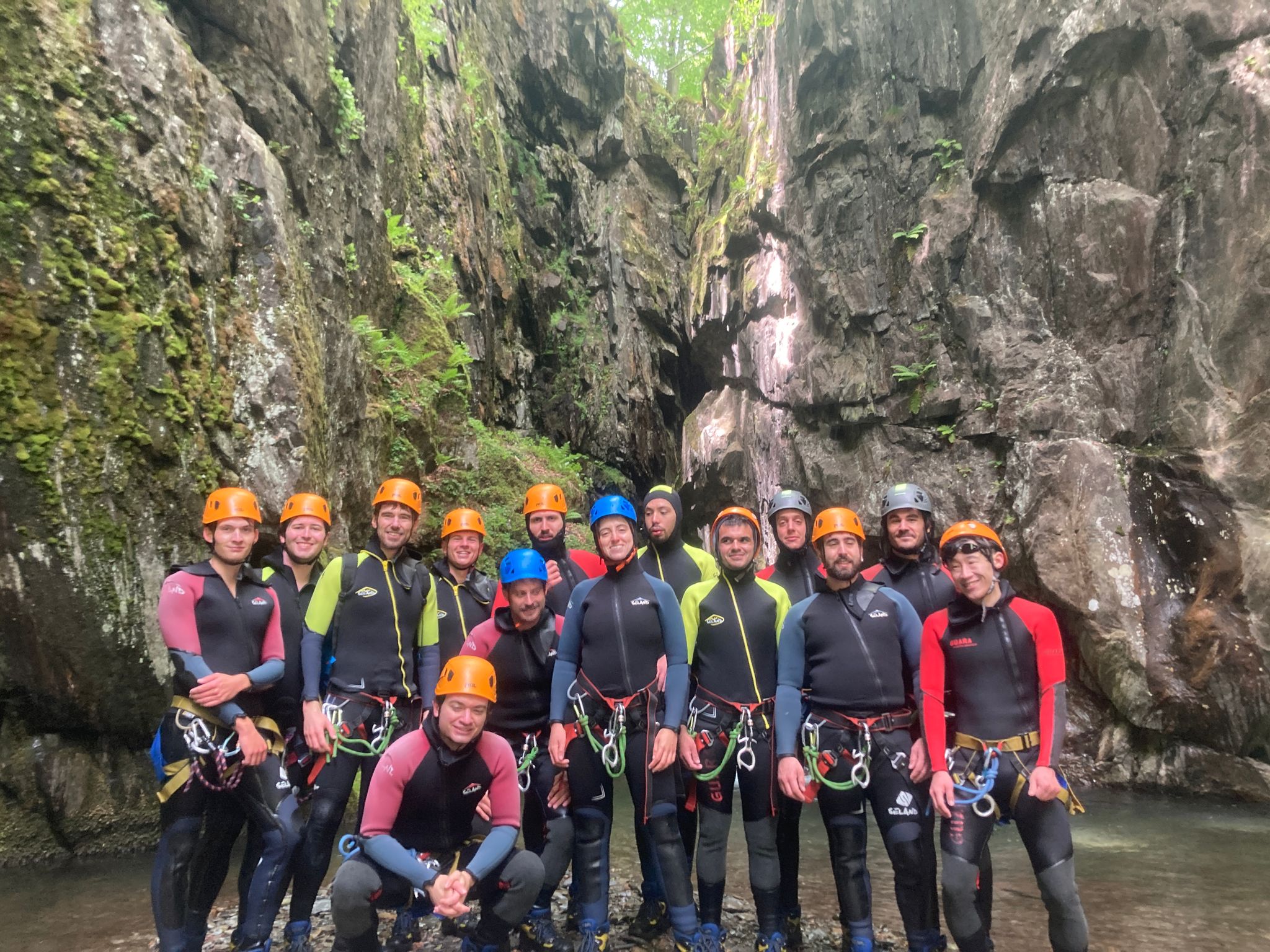
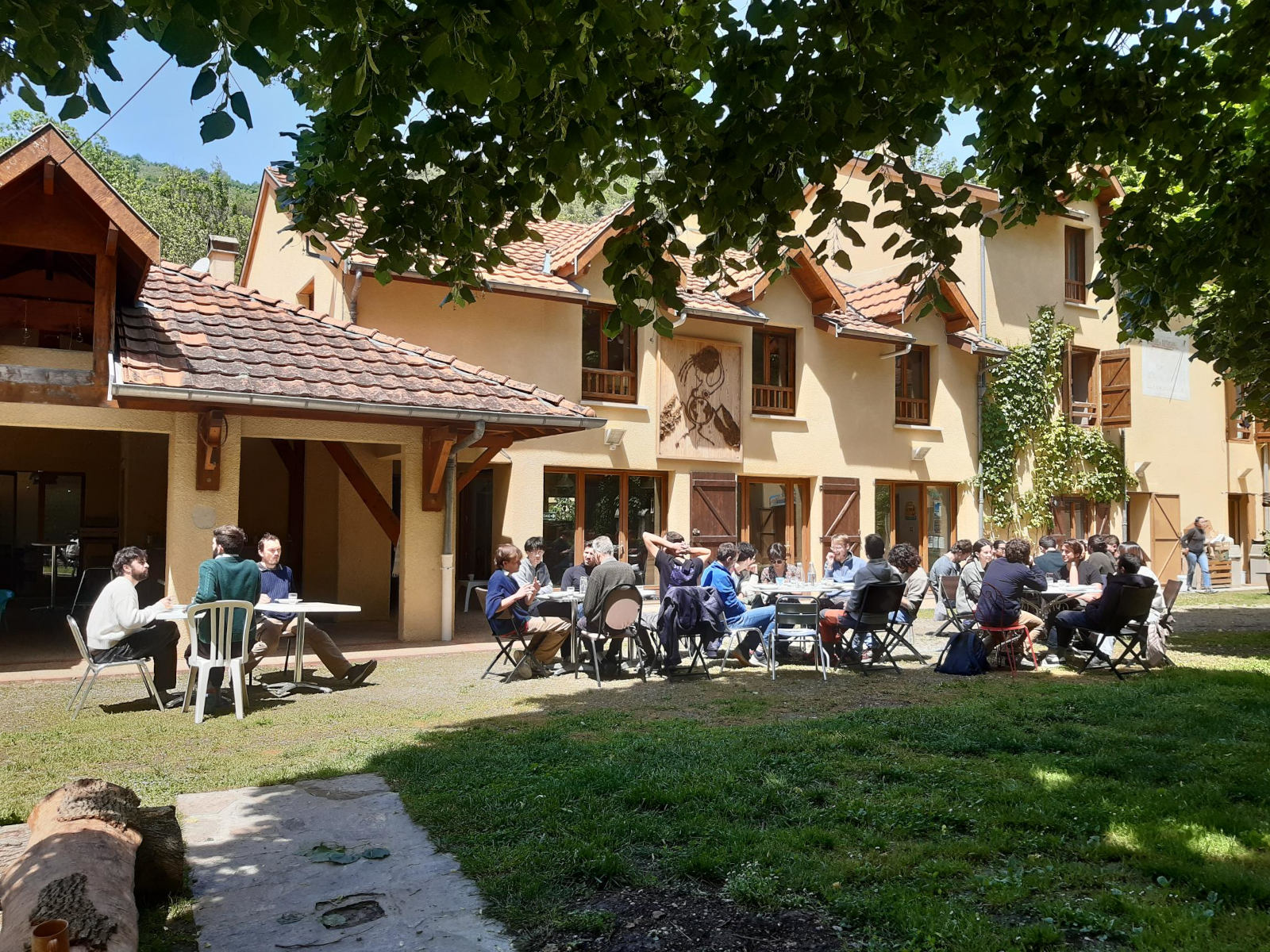
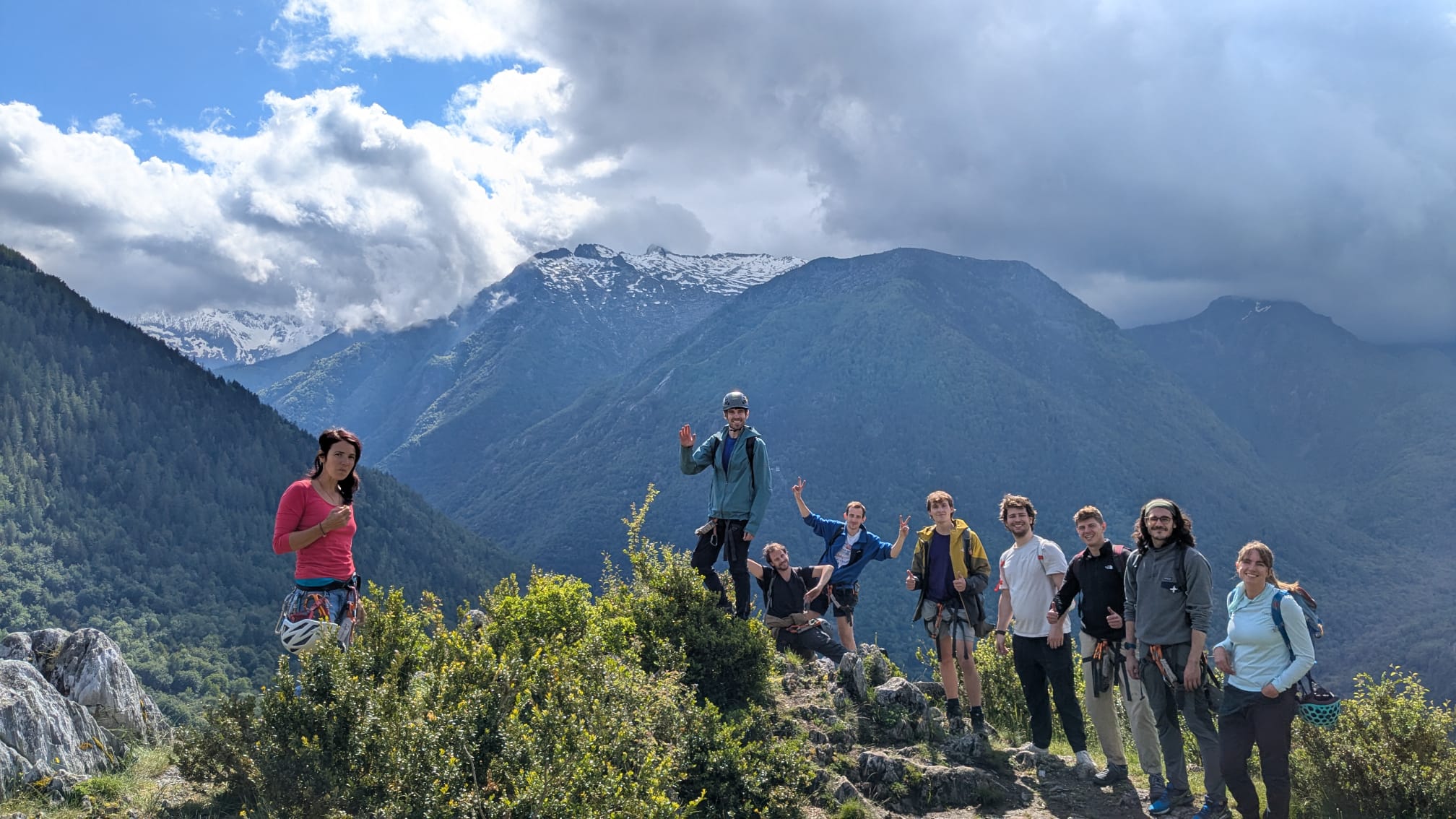
This event is the continuation of our 2025 spring school which gathered 30 participants and 10 teachers in the Pyrenees for a week of scientific exchanges. Photos used throughout this page are from that first edition. Our aim going forward is to keep improving the lecture contents and offer an original synthesis of the field.
Total fees cover tuition, accommodation (shared rooms 2-4 people), and vegetarian meals.
Before March 15
Before May 15
Mountaineering activities with a local guide: via ferrata, canyoning, rock climbing.
Guided tour of the Cathar castle of Montsegur: €13
The school will take place at the Domaine d'Arignac in the French Pyrenees. The nearest train station, Tarascon-sur-Ariège, is very close by, with hourly trains from the regional capital Toulouse, and a direct night train from Paris.
The venue offers a peaceful setting conducive to focused learning and informal scientific exchange, amidst the mountains and many opportunities for outdoors activities.
The organizers will stay at the nearby Institut Natura e Teoria en Pireneus (INTP), a communal research lab and residence center run as a non-profit by a mix of academic and independent researchers, who organize these schools without external funding.
Application deadline: March 15, 2026 (Early bird)
Applicants should submit the following documents to contact@intp.science:
The lectures will take place over 7 half-days (Sunday afternoon and every morning from Monday to Saturday). Afternoons are reserved for outdoor activities and informal discussions. Click on each day to see the detailed schedule.
Monday through Friday afternoons are reserved for optional outdoor activities and informal scientific discussions.
The lecture materials are created by a team of researchers with a physics background, currently working on both sides of the interface between physics and community ecology. One originality compared to most schools is that the team works collaboratively on creating all materials, to progress toward unifying and synthesizing our perspectives.